 Taken at its broadest, Natalia Savvides' The Lightbox is a wide-ranging meditation on the human condition: what makes us tick and what happens when said ticking turns to tocking, or an irregular rhythm. Who's to say what reality or truth are; where or in whom they might reside? Reality is subjective and only really definable by consensus, of which not everyone is a part, or always a part. It takes all kinds.
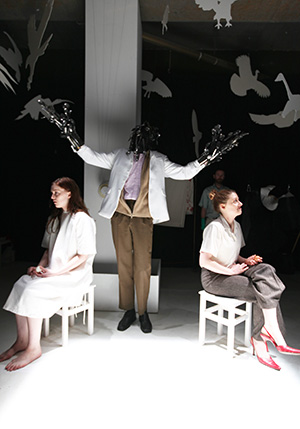
 The severe limitations of 107 Projects' Redfern Street space (anything but a purpose-built theatre) have been almost entirely surmounted, thanks to Dylan Tonkin's clever design. We barely even notice the massive concrete pillar stage right. And the headspace is populated by a flock of birds, rigged I know not how, but able to be raised and lowered with the greatest of ease by cast members. One moment our heads are in the clouds; the next, our feet are firmly on the ground. And so it is with life in general. No secret is made of the mechanics of the production: a toucan costume (also by Tonkin and also brilliant) hangs on high-tech tenterhooks; costume changes happen before our very eyes. I find this candidness both brave and disarmingly honest.
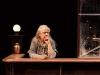
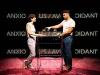
Making friends, lovers, enemies and other connections (and disconnections) is risky business and, to a very large extent, the business of life. Ethel (Hannah Barlow) meets Annie (Stephanie King) in an office cafeteria. Stabbing another with a spoon is one way to express oneself and this is way Ethel does to Annie. It lands her in an asylum where, aside from a propensity to pee on the floor, she seems to remain reasonably benign. Annie, meanwhile, becomes strangely and worryingly attached to the spoon which juts from her hand. Nevertheless, she requests that Lenny (Tom Christopherson) remove it. Next thing you know, she misses it. We're reminded just how fine the line between pleasure and pain. Otherwise, why would we allow ourselves to fall in love? One suspects a long history of co-dependent rescue between Annie and Lennie; it lurks and hovers, menacingly, like that hungry flock of faux gulls.
Hannah's chances of a recovery, for which she's only intermittently motivated, are rendered slimmer, one fears, by the fact that her psychiatrist is not only (nick)named Spoons, he is a spoon man. That's right, a spoon man: his face and hands are composed of a clanking collection of the voluptuous utensils. At least, this is how she sees him. As do we. On that basis, we may well be in dire need of therapy too. And, just perhaps, if there is a point, or if there are points, maybe this is one of 'em. Who's to say who's sane and who's 'mad'? There's been at least the odd occasion when it's struck me that acutely to chronically psychotic people I've encountered or known seem, at least, much saner than people I run into day in, day out, in the ordinary course of events in the 'real' world. And they vote. Otherwise, Corey Bernardi, Barnaby Joyce and Bob Katter wouldn't be sitting in federal parliament.
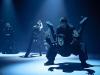
You'll be getting the general idea The Lightbox deals as much in shadows as light and further evidence of its cut-and-pasted, stream of consciousness nature can be found in its multiplicity of settings and scenes, which transport us from the depersonalised cafeteria mentioned to a nursery, a sterile (aside from Ethel's pee on the floor) room in a mental institution, the deck of a ship, a taxidermist's, jungle in South America, doctor’s office and, finally, an ocean clifftop. It's quite a journey. It's very restlessness, geographical and temporal, is emblematic of the restlessness of our own lives; in jobs, marriages and other relationships. It seems hellbent on setting-up a polemic of love versus freedom, postulating the mutual exclusivity of the two. Well, that's what I reckon. It's one of those plays that leaves loose ends for you to tie your own knots. And knots for you to unravel in your own time and way. Or not.
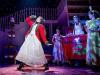
King also plays Ethel's mother, Lesley, making windswept passage along the Panama Canal. Cyril (Christophersen), her reluctant husband, sits behind, perusing The Times, doing his best of British to navigate around any sign of the attachment or affection Lesley craves. But this is all in the past. Also occupying the misty, mythical space of memory is Lesley's jungle encounter with a toucan (Dean Mason), who overwhelms her with his breathtaking beauty. In fact, he totally consumes her. But that's yet another story. Much as Lesley desires connection with Cyril, when the pressure to succeed in love in conventional terms becomes too much she escapes to the weirdness and wildness of that jungle and her splendidly-coloured bird. It's a dreamlike way of encapsulating the ironic, almost universal quest for intimacies that so often end up imprisoning us.
Meanwhile, back in Ethel's room, she's becoming increasingly chummy with the janitor (Mason), who almost revels in the repetitive ritual of mopping up her urinary output. All at once he's warm, funny and charming, but it's a ruse: he's preying on her vulnerability.
You'll be doing well to crack the code, if one pertains. It's better to approach as you might a dream. To let it wash over you, with all its illogical intensity, in irregular waves. It's almost psychedelic in its effect; its rhythms relate to unfamiliar time signatures. Tonkin's extraordinary design is strongly supported by Benjamin Brockman's lighting and Nate Edmondson's unobtrusive but noteworthy composition and sound. Here is a burgeoning Philip Glass or Michael Nyman.
Savvides has created something magical and the final conjuring trick is having James Dalton direct a well-matched and brilliant young cast, with King and Christophersen proving especially versatile and luminous.
FAT BOY DANCING and we do not unhappen present
THE LIGHT BOX
by Natalia Savvides
Director James Dalton
Venue: 107 Projects | 107 Redfern St, Redfern NSW
Dates: 10 – 28 July 2013
Tickets: $25 – $20
Bookings: www.fatboydancing.com/thelightbox